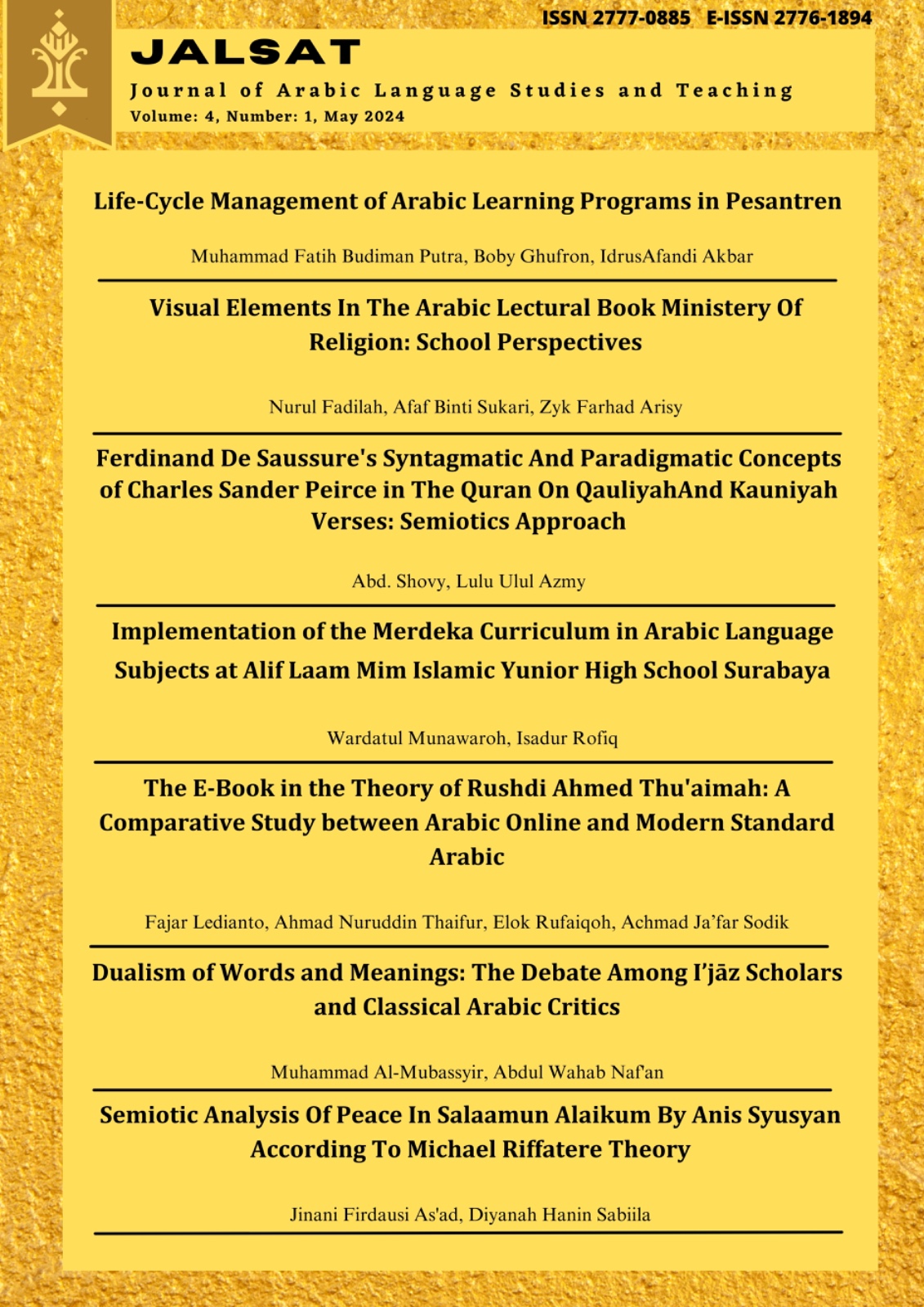
Semiotic Analysis Of Peace In Salaamun Alaikum By Anis Syusyan According To Michael Riffatere Theory
DOI:
https://doi.org/10.15642/jalsat.2024.4.1.113-129Keywords:
Peace, "Salamun 'Alaikum" Poetry, Anis Chouchene, Riffaterre SemioticsAbstract
The poem "Salamun 'Alaikum" by Anis Chouchene is a compelling subject for analysis due to its exploration of the theme of peace, which was once lost in Tunisia. This study aims to uncover the full significance of the poem. Utilizing Riffaterre's semiotic approach, the research involved text observation, data source identification, and multiple readings of the poem. The findings are summarized as follows: (1) Heuristic reading reveals that the poem employs accessible language and personification, along with numerous affirmations to underscore the poet's viewpoint. (2) Hermeneutic reading suggests that the poem is a response to an incident of racism in Tunisia, with the poet expressing personal feelings and recommending actions for Tunisian citizens. (3) The underlying matrix of the poem is the theme of peace, which the poet seeks to communicate to the broader public, especially the Tunisian population, which was grappling with racism at the time.
Downloads
References
Al-askandary, Musthafa. 1916. Al-Wasith Fiy Adaab al-Araabiy Wa Tarikhihi. Mesir: Daar al-Ma’aarif.
Amir Karim, Muhdie. 2021. “Pemahaman Makna Kedaaian Dan Gaya Bahasa Syair Assalam Karya Anis Chauchane.” Nady Al-Adab 18(1).
As-shargini, Muhammad. 2016. Muhadharat Fi As-Simiyulujiyyah. Amman: Dar at-tsaqafah.
Aziz, Husein. 2013. Ilmu Balaghah. Surabaya: UIN Sunan Ampel Press.
Az-Zubaidi. 1965. Taj Al-Arus. Kuwait: Majlis wathani.
Badar, Ali. 1984. Muhadharah Fiy Al-Ilmi al-Arudl. Cairo: Al-azhar University.
Chandler, Daniel. 2008. Asas As-Simiyulujiyyah. Beirut: Dirasat al-wahdah al-arabiyah.
Eco, Umberto. 1998. Semiotics and the Philosophy of Language. Beirut: Markaz dirasah wihdah al-arabiyah.
Firuzabadi. 2005. Mu’jam al-Muhith. Beirut: Muassasah ar-risalah wa at-thiba’ah.
Ibn Faris. 1979b. Mu’jam Maqaayis al-Lughah. Damaskus: Dar al-Fikr.
Ibn katsir. 2000. Al-Mishbah al- Munir. Cairo: al-Maktabah al-Islamiyah.
Ibn Mandzur. 2009. Lisaan Al-Araab. Beirut: Daar-al-shadir.
Kartini. 1996. Metodologi Riset Sosial. Bandung: Bandar Maju.
Luwais Al-Ma’luf. 1977. Al-Munjid Fiy al-Lughah Wa al-A’lam. Beirut: Dar al- Masyriq.
Muhammad, Hasan. 1921. Jauhar Aalam Syu’ub Tunis. Mesir: Dar al-Ma’rifah.
Nuthawwir, Dhaif. 2014. “Peace in the Holy Qur’ān: An Objective Study.” Al-Bassera 203.
Rahman, Musyfiqur. 2017. Kitab Asmara Terjemah Puisi. Yogyakarta: Ganding Pustaka.
Rahmat, Pupu Saeful. 2009. “Penelitian Kualitatif.” Jurnal Equilibrium 5(9).
Ratna, N. K. 2013. Teori, Metode, Dan Teknik Penelitian Sastra. Yogyakarta: Pustaka Pelajar.
Rifaterre Michael. 1984. Semiotics of Poetry. London: Indiana of University Press.
Santosa, P. 2013. Ancangan Semiotika Dan Pengkajian Susastra. Bandung: Angkasa.
Siswantoro. 2010. Metode Penelitian Sastra: Analisis Struktur Puisi. Yogyakarta: Pustaka Pelajar.
Sugiyono. 2015. Metode Penelitian Kombinasi. Bandung: Alfabeta.
Taufiq M. A., & Elseed, M. E. G. (2023). Al-Ārā’ al-Balāghiyyah li Sheikh al-Azhar Muḥammad Sayyid Ṭanṭāwī fī Tafsīr al-Wasīṭ [Arabic Rhetorical Opinions of Sheikh al-Azhar Muhammad Sayyid Tantawi in the Tafsir al-Wasit]. OKARA: Jurnal Bahasa Dan Sastra, 17(2), 265-281. https://doi.org/10.19105/ojbs.v17i2.10071
Waluyo, H. 1987. Teori Dan Apresiasi Puisi. Jakarta: Erlangga.
Downloads
Published
Versions
- 12-09-2024 (2)
- 30-05-2024 (1)
How to Cite
Issue
Section
License
Copyright (c) 2024 Jinani Firdausi As'ad, Diyanah Hanin Sabiila

This work is licensed under a Creative Commons Attribution 4.0 International License.