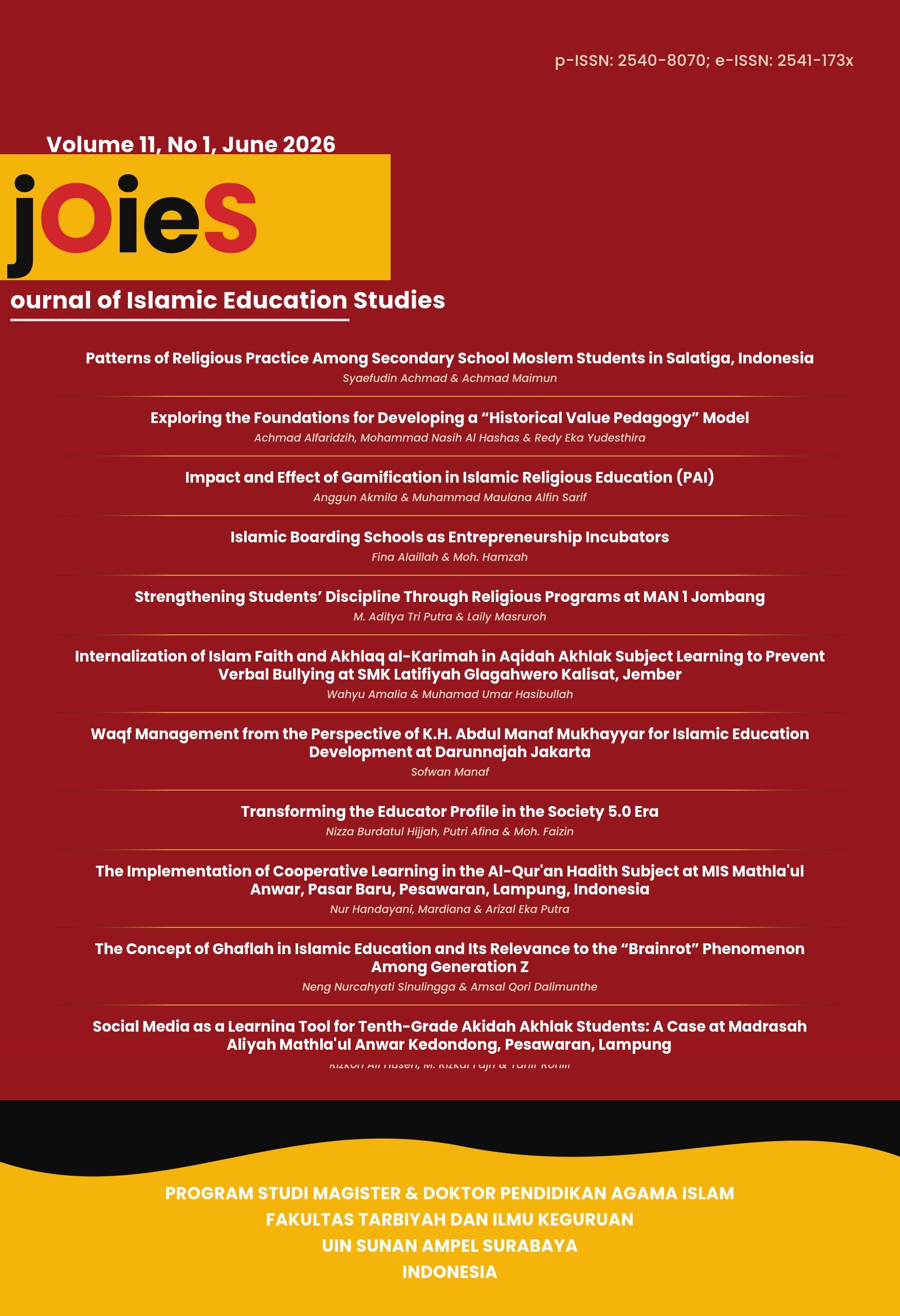
Exploring the Foundations for Developing a “Historical Value Pedagogy” Model
The Role of History of Islamic Culture (SKI) Learning in Students’ Internalization of Islamic Values
DOI:
https://doi.org/10.15642/joies.2026.11.1.27-54Keywords:
SKI learning, value internalization, Historical Value Pedagogy, Islamic educationAbstract
Abstract: This study aims to analyze the contribution of Sejarah Kebudayaan Islam (SKI) learning to the internalization of Islamic values among students and to explain the underlying pedagogical–psychological mechanisms as a basis for formulating the Historical Value Pedagogy model. The study employs a mixed methods approach with a sequential explanatory design, combining quantitative analysis through Structural Equation Modeling (SEM) and qualitative analysis through in-depth interviews. The findings indicate that SKI learning has a positive effect on value internalization, although within a weak category, while its influence on psychological processes is relatively stronger. Psychological processes function only as a partial mediator with limited contribution, resulting in suboptimal value internalization. Qualitative findings reveal that learning remains dominated by a cognitive approach and is not sufficiently supported by reflection and habituation, preventing students’ affective responses from developing into behavioral outcomes. This study concludes that value internalization requires an integrative and transformative pedagogical approach. Accordingly, the *Historical Value Pedagogy* model is proposed, integrating historical understanding, affective engagement, reflection, habituation, and behavioral actualization as a framework for strengthening SKI learning.
Downloads
References
Al-Attas, Syed Muhammad Naquib. Islam and Secularism. Kuala Lumpur: IBFIM, 2019.
Alfaridzih, Achmad, Ahmad Faidhullah Akbar, Akhmad Najikh, and Romi Faslah. “Internalisasi Nilai-Nilai Pendidikan Akhlak Melalui Program �Brascho Nyantrik� Di SMA Brawijaya Malang.” Ideas: Jurnal Pendidikan, Sosial, Dan Budaya 10, no. 1 (February 20, 2024): 133. https://doi.org/10.32884/ideas.v10i1.1648.
Alfaridzih, Achmad, Abdul Fattah, Imam Patkuroji, Faila Sufah, Lintang Ramadhani, Hilya Adilah, Muhammad Sahal Malik Fajar, M. Faiq Faizin, and Ahmad Barizi. “Dinamika Kelembagaan Pendidikan Islam Di Indonesia,” 2025.
Alfaridzih, Achmad, Redy Eka Yudesthira, Nuriyatul Qomariyah, M Darul Ulum, Lailatun Nurul Maulidah, Universitas Sunan Gresik, Maulana Malik, and Ibrahim Malang Alamat. “RASULULLAH SEBAGAI ROLE MODEL DALAM PENDIDIKAN : INSPIRASI PENDIDIKAN KARAKTER BAGI GENERASI MUDA KAJIAN TERHADAP SURAT AL-AHZAB AYAT 21.” Pendas : Jurnal Ilmiah Pendidikan Dasar 10, no. 04 (December 27, 2025): 232–46. https://doi.org/10.23969/JP.V10I04.39402.
Anggraeni, Arista. “Studi Literatur Stimulasi Peningkatan Hasil Belajar PAI Dan Budi Pekerti Melalui Penerapan Pendekatan Sosio Emosional Pada Peserta Didik.” JOIES (Journal of Islamic Education Studies) 10, no. 1 (July 28, 2025): 25–46. https://doi.org/10.15642/joies.2025.10.1.25-48.
Auliya’, Hilyatul. “Analisis Ketidaktuntasan Materi PAI Dalam Proses Pembelajaran.” JOIES (Journal of Islamic Education Studies) 10, no. 1 (July 29, 2025): 83–104. https://doi.org/10.15642/joies.2025.10.1.83-104.
Bandura, Albert. Social Learning Theory . Rev. London: Routledge, 2020.
Barton, Keith C., and Linda S. Levstik. Teaching History for the Common Good. New York: Routledge, 2018.
Berkowitz, Marvin W., and Melinda C. Bier. “Research Based Character Education.” Annals of the American Academy of Political and Social Science 591 (January 2004): 72–85. https://doi.org/10.1177/0002716203260082.
Berkowitz, Marvin W., and Melinda C. Bier. “ Research-Based Character Education.” Journal of Moral Education 50, no. 1 (2021): 1–16.
Børte, Kristin, Katrine Nesje, and Sølvi Lillejord. “Barriers to Student Active Learning in Higher Education.” Teaching in Higher Education 28, no. 3 (April 3, 2023): 597–615. https://doi.org/10.1080/13562517.2020.1839746.
Braun, Virginia, and Victoria Clarke. “Using Thematic Analysis in Psychology.” Qualitative Research in Psychology 3, no. 2 (January 21, 2006): 77–101. https://doi.org/10.1191/1478088706qp063oa.
Chinn, Clark., and Ravit Golan. Duncan. International Handbook of Inquiry and Learning. Routledge, 2021.
Cohen, Louis, Lawrence Manion, and Keith Morrison. Research Methods in Education. London: Routledge, 2017. https://doi.org/10.4324/9781315456539.
Creswell, J.W., and J.D. Creswell. Research Design: Qualitative, Quantitative, and Mixed Methods Approaches. Los Angeles: SAGE, 2018.
Creswell, John W.., and Vicki L.. Plano Clark. Designing and Conducting Mixed Methods Research. SAGE, 2018.
Durlak, Joseph A, Roger P Weissberg, Allison B Dymnicki, Rebecca D Taylor, and Kriston B Schellinger. “The Impact of Enhancing Students’ Social and Emotional Learning: A Meta-Analysis of School-Based Universal Interventions.” Child Development 82, no. 1 (January 1, 2011): 405–32. https://doi.org/10.1111/j.1467-8624.2010.01564.x.
Eisenberg, Nancy, Tracy L. Spinrad, and Ariel Knafo‐Noam. “Prosocial Development.” In Handbook of Child Psychology and Developmental Science, 1–47. Wiley, 2015. https://doi.org/10.1002/9781118963418.childpsy315.
Guest, Greg, Arwen Bunce, and Laura Johnson. “How Many Interviews Are Enough?” Field Methods 18, no. 1 (February 1, 2006): 59–82. https://doi.org/10.1177/1525822X05279903.
Haidt, Jonathan. “Elevation and the Positive Psychology of Morality.” In Flourishing: Positive Psychology and the Life Well-Lived., 275–89. Washington: American Psychological Association, 2003. https://doi.org/10.1037/10594-012.
Hair, Joseph F.., G. Tomas M.. Hult, Christian M.. Ringle, and Marko. Sarstedt. A Primer on Partial Least Squares Structural Equation Modeling (PLS-SEM). Sage, 2017.
Hulders, Iris, Michiel Voet, and Bram De Wever. “THE IMPACT OF TEACHERS’ BELIEFS AND STUDENTS’ EPISTEMOLOGICAL UNDERSTANDING AND ENGAGEMENT IN HISTORY ON STUDENTS’ ARGUING SKILLS,” 6587–93, 2021. https://doi.org/10.21125/edulearn.2021.1335.
Immordino-Yang, Mary Helen, Linda Darling-Hammond, and Christina R. Krone. “Nurturing Nature: How Brain Development Is Inherently Social and Emotional, and What This Means for Education.” Educational Psychologist 54, no. 3 (July 3, 2019): 185–204. https://doi.org/10.1080/00461520.2019.1633924.
Ivankova, Nataliya V., John W. Creswell, and Sheldon L. Stick. “Using Mixed-Methods Sequential Explanatory Design: From Theory to Practice.” Field Methods 18, no. 1 (February 1, 2006): 3–20. https://doi.org/10.1177/1525822X05282260.
Joseph, F., Hair, Black William, C., Babin Barry, J., and Anderson Rolph, E. Multivariate Data Analysis. Cengage, 2019.
Kline, R. B. Principles and Practice of Structural Equation Modeling. Guilford Press, 2016.
Kline, Rex B.., and Todd D.. Little. Principles and Practice of Structural Equation Modeling. The Guilford Press, 2016.
Leppink, Jimmie. “Learning Processes,” 3–19, 2020. https://doi.org/10.1007/978-3-030-43082-5_1.
Livingstone, Sonia, and Amanda Third. “Children and Young People’s Rights in the Digital Age: An Emerging Agenda.” New Media & Society 19, no. 5 (May 10, 2017): 657–70. https://doi.org/10.1177/1461444816686318.
Mardhiah, Izzatul, Andy Hadiyanto, Amaliyah Amaliyah, and Ahmad Hakam. “Developing Learning Competencies of Multicultural and Local Wisdom Values-Based Islamic Religious Education in Higher Education in Indonesia.” Hayula: Indonesian Journal of Multidisciplinary Islamic Studies 5, no. 1 (January 29, 2021): 81–92. https://doi.org/10.21009/005.01.04.
Merriam, Sharan B.., and Elizabeth J.. Tisdell. Qualitative Research : A Guide to Design and Implementation. John Wiley & Sons, 2016.
Minan, M A, N Z Adriansyah, A F Almas, I Riyadi, and T T Prabowo. “Construction of Islamic Education Based on Islamic Boarding Schools: A Case Study at Al-Manar Muhammadiyah Modern Islamic Boarding School in South Sumatra.” Jurnal Pendidikan Agama Islam 22, no. 1 (2025): 195–214. https://doi.org/10.14421/jpai.v22i1.11044.
Nucci, Larry, Tobias Krettenauer, and Winston C. Thompson. Handbook of Moral and Character Education. New York: Routledge, 2024. https://doi.org/10.4324/9781003374077.
Odgers, Candice L., and Michaeline R. Jensen. “Annual Research Review: Adolescent Mental Health in the Digital Age: Facts, Fears, and Future Directions.” Journal of Child Psychology and Psychiatry 61, no. 3 (March 17, 2020): 336–48. https://doi.org/10.1111/jcpp.13190.
OECD. Beyond Academic Learning. OECD, 2021. https://doi.org/10.1787/92a11084-en.
———. PISA 2022 Results (Volume I). OECD Publishing, 2023. https://doi.org/10.1787/53f23881-en.
Patton, Michael Quinn. Qualitative Research & Evaluation Methods : Integrating Theory and Practice. SAGE Publications, Inc., 2015.
Pohling, Rico, and Rhett Diessner. “Moral Elevation and Moral Beauty: A Review of the Empirical Literature.” Review of General Psychology 20, no. 4 (December 1, 2016): 412–25. https://doi.org/10.1037/gpr0000089.
Sari, M, D Asrida, L S Muchlis, V R Febrian, and N Azizah. “TRANSFORMATIONAL LEADERSHIP IN ISLAMIC EDUCATION INSTITUTION THROUGH SOCIAL MEDIA ENGAGEMENT.” Jurnal Pendidikan Islam 10, no. 2 (2024): 336–49. https://doi.org/10.15575/jpi.v10i2.40221.
Seixas, Peter., Tom. Morton, Jill. Colyer, and Stefano. Fornazzari. The Big Six : Historical Thinking Concepts. Nelson Education, 2013.
Shadish, William R.., Thomas D.. Cook, and Donald T.. Campbell. Experimental and Quasi-Experimental Designs for Generalized Causal Inference. Houghton Mifflin, 2002.
Sugiono. Meotode Penelitian Kuantitatif, Kualitatif Dan R&D. Cet. 1. Bandung: Alfabeta, 2019.
Thomson, Andrew L., and Jason T. Siegel. “A Moral Act, Elevation, and Prosocial Behavior: Moderators of Morality.” The Journal of Positive Psychology 8, no. 1 (January 2013): 50–64. https://doi.org/10.1080/17439760.2012.754926.
———. “Elevation: A Review of Scholarship on a Moral and Other-Praising Emotion.” The Journal of Positive Psychology 12, no. 6 (November 2, 2017): 628–38. https://doi.org/10.1080/17439760.2016.1269184.
UNESCO. Reimagining Our Futures Together: A New Social Contract for Education . Paris: UNESCO, 2021.
VanSledright, Bruce. Assessing Historical Thinking and Understanding : Innovative Designs for New Standards. Routledge, 2014.
Woods, Peter J., and Y. Copur-Gencturk. “Examining the Role of Student-Centered versus Teacher-Centered Pedagogical Approaches to Self-Directed Learning through Teaching.” Teaching and Teacher Education 138 (February 2024): 104415. https://doi.org/10.1016/j.tate.2023.104415.
Zhang, Yuemei, Mingwei Bu, and Haitao Liu. “Moral Elevation and Prosocial Behavior in College Students: The Mediating Role of Gratitude and the Moderating Role of Empathy.” Frontiers in Psychology 17 (March 24, 2026). https://doi.org/10.3389/fpsyg.2026.1784102.
Downloads
Published
How to Cite
Issue
Section
License
Copyright (c) 2026 Achmad Alfaridzih, Mohammad Naih Al Hashas, Redy Eka Yudesthira, Desi Kurniawan, Devi Wulansari

This work is licensed under a Creative Commons Attribution-NonCommercial 4.0 International License.