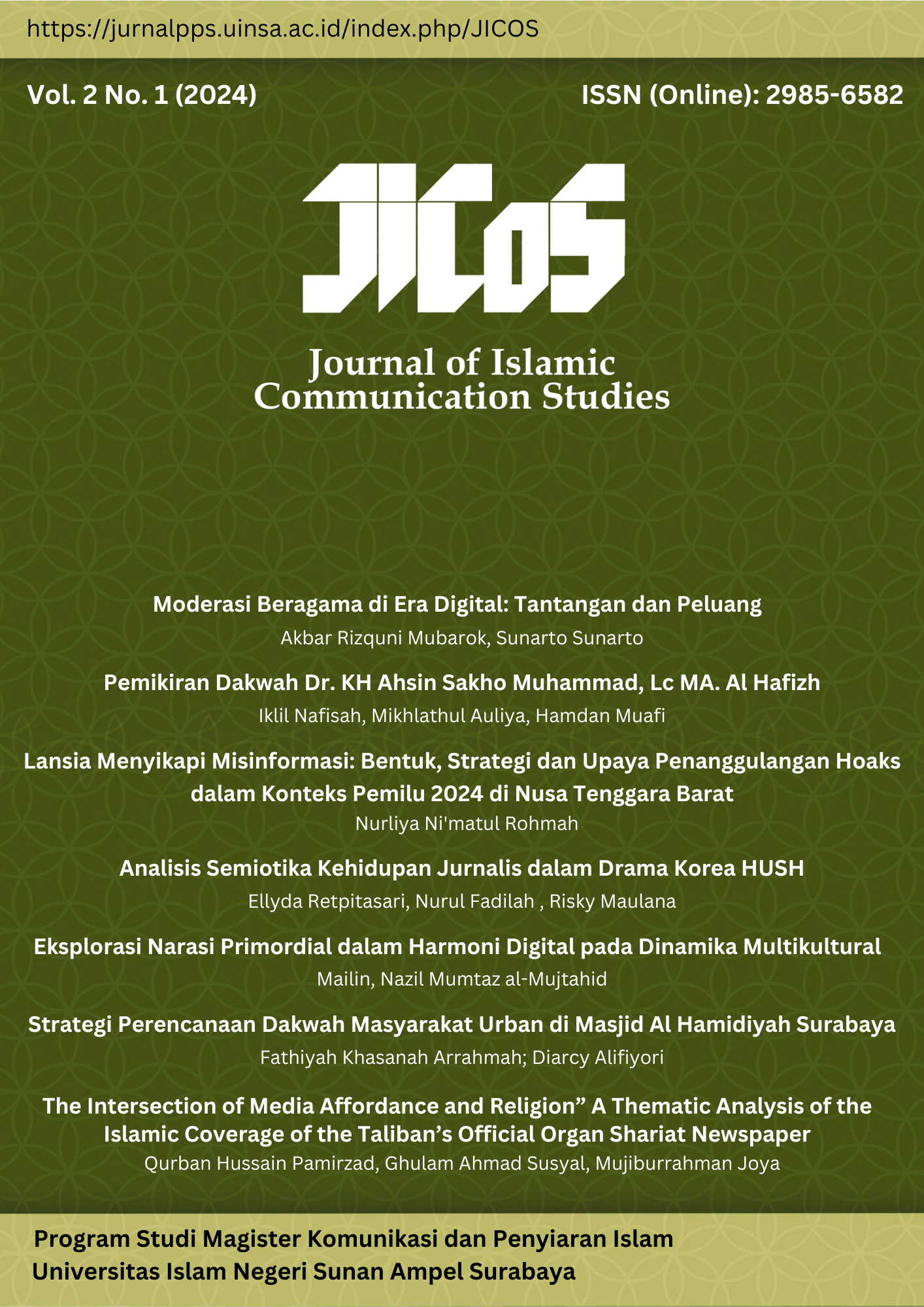
The Intersection of Media Affordance and Religion
A Thematic Analysis of the Islamic Coverage of the Taliban’s Official Organ Shariat Newspaper
DOI:
https://doi.org/10.15642/jicos.2024.2.1.66-75Keywords:
Afghanista Media, Media Affordance, Religious Broadcasting, Islamic Topic, Shariat NewspaperAbstract
The relationship between religion and media has been one of the topics of research interest. This study employed the media affordance concept and explored the religious coverage of the Shariat newspaper, which is the official organ of the Taliban government. The study examines how the official organ of the Taliban government covers and contributes to Islamic content dissemination and how it is used to distribute its ideology. Employing a mixed quantitative and qualitative analysis, this study found that the Taliban used the media's spatiotemporal, technological, and socio-lingual affordances to spread their narrative and Islamic issues through this publication. At the same time, through thematic analysis, this study noticed that Islamic topics susceptible to multi-interpretability were also covered in this newspaper. However, the quality of the content published might not be convincing and comprehensive enough for the reader who wants to satisfy their curiosity. In addition, it was noticed that a selective approach was employed in writing these issues to serve ideological justification.
Downloads
References
AfghanistanConstitution. (1964). AfghanistanConstitution. Official Gazette, Article 31.
Accessed (Nov 2023) https://drive.google.com/file/d/1HQzgrybwn1lzsgHVtZsQDyourXaSceKN/view.
Ahang, M. K. (1970). A Short History of Journalism in Afghanistan. Kabul: The historical and literary society of Afghanistan Academy.
Al-Rawi, A. K. (2012). Iraqi Media: The Beginnings. Media Practice in Iraq, 6-27. https://doi.org/10.1057/9781137271648_2
Aman-e-Afghan. (1920, March 30). The importance of Turkish peace. Aman-e-Afghan. Accessed (Jan 2024) https://bit.ly/48zV8rT.
BBC. (2019, Mar 23). The rise and fall of the Islamic State Group: The long and short story. BBC-Middle East. Accessed (Feb 2024) https://www.bbc.com/news/world-middle-east-47210891
BBC_Persian .(2011, October 4). مطبوعات تریبونی برای احزاب سیاسی [The press as a tribune of the political parties]. BBC Persian. Accessed (Jan 2024) https://www.bbc.com/persian/afghanistan/2011/10/111004_k02-mm-century-afghan-press_sh09
Brubaker, P. J. (2017). The religious Facebook experience: Uses and gratifications of faith-based content. Social Media+ Society, 3(2): https://doi.org/10.1177/2056305117703723
Gaddy, G. D. (1984). The Power of the Religious Media: Religious Broadcast Use and the Role of Religious Organizations in Public Affairs. Review of Religious Research, 25 (4) 289–302. https://doi.org/10.2307/3511363
Gregorian, V. (1967). Mahmud Tarzi and Saraj-Ol-Akhbar: Ideology of Nationalism and Modernization in Afghanistan. JSTOR-Middle East Journal, 21 (3) 345–68. Accessed 5 Feb. 2024. http://www.jstor.org/stable/4324163
Ibrahimi, Z. &. Nabawi, S.M (2015). [Critique of the Lexicology of Translation of Hijab Verses in New Persian Translations] نقد و بررسی واژه شناسانه ترجمه آیات حجاب در ترجمه های جدید فارسی. Noor Professional Magazines. Accessed (Jan 2024) https://www.noormags.ir/view/fa/articlepage/1400435.
Kadivar, J . (2020). Exploring Takfir, Its Origins and Contemporary Use: The Case of Takfiri Approach in Daesh’s Media. Contemporary Review of the Middle East, pp. 1–27. https://doi.org/10.1177/2347798920921706
Kelidar, A. (2002). The political press in Egypt, 1882–1914. In Contemporary Egypt: Through Egyptian Eyes (pp. 13-33). Routledge.
McDonnell, J. (2023). Religious Broadcasting: An Overview, 2000–2021. The Handbook of Religion and Communication. https://doi.org/10.1002/9781119671619.ch10
Muchtar, N., Hamada, B. I., Hanitzsch, T., Galal, A., Masduki, & Ullah, M. S. (2017). Journalism and the Islamic worldview: Journalistic roles in Muslim-majority countries. Journalism Studies, 18(5), 555-575. https://doi.org/10.1080/1461670X.2017.1279029
Nojumi, N . ( 2002).The Afghan Mujahideen and Mass Mobilization: The Rise of the Taliban in Afghanistan. New York: Palgrave Macmillan. https://doi.org/10.1007/978-0-312-29910-1_7
Pervez, S. (2015, Feb 15). Hijab In Islam: Modesty, Humility and Dignity. Why Islam? https://www.whyislam.org/hijab-in-islam-modesty-humility-and-dignity
Qiang, C. & Pamirzad, Q.H. (2023). A Century of Struggle: Afghanistan’s Media Development Under Monarchies" The 5th International Journalism and Communication Education Forum and the 1st Central-South-West Asia International Communication Summit Forum At Xi'an City, People's Republic of China. Accessed (Feb 2024) https://www.researchgate.net/publication/375770875_A_Century_of_Struggle_Afghanistan%27s_Media_Development_Under_Monarchies
Raheen, R. (2008). Jarida Saraj-ul-Akhbar Afghanya," Zendagi. Accessed (Jan 2024) https://www.zendagi.com/new_page_1698.htm
Rahnama, A. A. (2014). بررسی مفهوم حجاب در متون اسلامی جایگاه آثار و جلوه های تربیتی آن [The Concept of Hijab in Islamic Texts The Place of Works and Its Educational Manifestations]", Journal of Quranic Knowledge پژوهشنامه معارف قرآنی 6, 23. https://doi.org/10.22054/RJQK.2015.4501
Ratcliff, A. J. (2017). Religion and new media: A uses and gratifications approach," Journal of Media and Religion, 16(1) 15–26. https://doi.org/10.1080/15348423.2017.1274589
Salaam, B. (2023, August 10). Amid Taliban Repression, Afghan Media Are a Beacon of Hope. United States Institute of Peace. Accessed (18 April 2024) https://www.usip.org/publications/2023/08/amid-taliban-repression-afghan-media-are-beacon-hope
Shahidi, H. (2008). Iranian journalism and the law in the twentieth century. Iranian Studies, 41(5), 739-754. https://doi.org/10.1080/00210860802518376
Shir, J. (2012). Nationalism in Afghanistan: Colonial knowledge, education, symbols, and the World Tour of Amanullah Khan, 1901-1929" James Madison University (Masters Thesis), JMU Scholarly Commons. Accessed ( Jan 2024) https://commons.lib.jmu.edu/cgi/vi
Sputnik. (2021, Nov 3). [The Shariat Newspaper after 20 years is back again] روزنامه «شریعت» پس از 20 سال دوباره به فعالیت آغاز کرد. https://bit.ly/3wB13PM
Witte, M. D. (2018). Religion and Media. The International Encyclopedia of Anthropology. Accessed (Jan 2024) https://www.researchgate.net/publication/317544168_Religion_and_Media.
Wojcieszak, M., Nisbet, E. C., Kremer, L., Behrouzian, G., & Glynn, C. (2019). What drives media use in authoritarian regimes? Extending selective exposure theory to Iran," The International Journal of Press/Politics, 24(1) 69-91. https://doi.org/10.1177/1940161218808372
Downloads
Published
How to Cite
Issue
Section
License
Copyright (c) 2024 Qurban Hussain Pamirzad, Ghulam Ahmad Susyal, Mujiburrahman Joya

This work is licensed under a Creative Commons Attribution-NonCommercial 4.0 International License.
Licensing
© The Author(s). Published by Program Studi Magister Komunikasi dan Penyiaran Islam, Pascasarjana UIN Sunan Ampel Surabaya, Indonesia.
This is an Open Access article distributed under the terms of Attribution-NonCommercial 4.0 International (CC BY-NC 4.0).